
The e-commerce market is changing at lightning speed. Today, customers make decisions based not on brand or website design, but primarily on price. This is why monitoring competitors’ prices has become more than just an analytical tool, but a key element of a profitable sales strategy.
For online store owners, marketers, and brands, price control is a way to preserve margins, retain customers, and protect recommended retail prices (RRPs) from dumping. Understanding market price dynamics helps companies make informed decisions: when to lower prices, when to maintain them, and when to increase them while remaining competitive.
In this article, you will learn about the existing price monitoring methods, the differences between manual and automated analysis, how modern AI monitoring systems work, and the benefits companies receive by implementing such solutions. We will also examine real-world case studies and demonstrate how the Price Control service helps businesses manage prices, the market, and profits.
What is monitoring
First, let’s define the terms.
Competitor Price Monitoring is the regular tracking of prices, promotions, and availability of identical or similar products on competitors’ websites. The purpose of competitor price monitoring is to regularly reevaluate your own product prices based on market conditions to maximize profits. The primary tool for automatically collecting such information is price scraping.
Price monitoring refers to the systematic process of tracking and analyzing changes in the pricing of goods or services. Companies use this process to remain competitive, understand market trends, and adjust their pricing strategies accordingly. Price monitoring may include collecting current prices, studying discounts and promotions, and assessing changes in supply and demand in the market.
A simplified definition of monitoring is “tracking.”
Price tracking (price monitoring) is the regular collection of information about changes in the cost of goods that potential buyers are interested in online.
This can be done manually by frequently visiting seller websites or by delegating the task to specialized services using price comparison software. Price comparison tools automatically track product prices and provide customers with the best available deals.
Such tools can monitor prices across a single marketplace or store and collect data from multiple platforms. They can generate price snapshots on demand or notify users when a product’s price drops to a specific level.
Retail price monitoring can be especially beneficial for manufacturers when launching a new product. It helps reflect the success of the product rollout and identify shortcomings during marketing campaigns.
In e-commerce, successful sales heavily depend on current market prices. A potential buyer can quickly compare prices at your store and your competitors’ with just a few clicks and is likely to choose the most advantageous offer. Therefore, price monitoring should become a regular routine as one of the key success factors for any online retailer or supplier.
Now that we’ve clarified the terms, let’s delve into how competitor price monitoring aids in developing a company’s marketing strategy.
Goals and objectives of monitoring competitors’ prices
 This process serves several goals and objectives, helping businesses operate effectively in the market and maintain competitiveness.
Goals
- Assessing Competitiveness
Price monitoring provides insight into how a company’s pricing aligns with market standards and competitors. - Optimizing Pricing Strategy
Adjusting prices to enhance the attractiveness of offerings without compromising profitability. - Preventing Customer Loss
Avoiding scenarios where customers choose competitors due to lower prices. - Increasing Profit Margins
Identifying opportunities to improve margins through market price analysis. - Quick Market Adaptation
Responding promptly to competitor price changes to maintain market share.
Objectives
- Data Collection
Regularly gathering competitor pricing information from various channels, including websites, physical stores, and promotional activities. - Data Analysis
Comparing competitor prices with your own to identify trends and anomalies. - Defining Price Ranges
Establishing minimum, average, and maximum prices for similar products or services. - Adapting Pricing Policies
Developing recommendations to adjust pricing strategies to stay competitive. - Market Change Forecasting
Using collected data to predict market trends and their potential impact on business operations. - Tracking Discounts and Promotions
Monitoring competitors’ special offers to respond appropriately and in a timely manner.
Key Platforms for Online Price Monitoring
- E-commerce Websites
Tracking prices directly on online stores. - Price Aggregators
Observing trends on price comparison platforms. - Marketplaces
Analyzing competitor listings on platforms like Amazon, eBay, etc. - Search Engine Ads
Monitoring pricing in promotional advertisements on search engines. - Classified Ads Platforms
Checking electronic bulletin boards for competitor offerings.
Competitor price monitoring is essential for maintaining relevance and competitiveness in a dynamic market.

When Is Price Monitoring Necessary?

It is necessary in several situations to ensure competitiveness, optimize pricing strategies, and adapt to market dynamics effectively:
Key Situations Requiring Price Monitoring
- Entering a New Market
When launching a new product or entering a new market, understanding competitors’ pricing strategies is crucial to set competitive prices. - High Competition
In saturated markets with many similar offerings, regular price monitoring ensures competitiveness and helps retain customers. - Seasonal Demand Fluctuations
During periods of significant demand changes (e.g., holiday sales), price monitoring enables timely adaptation of pricing strategies. - Launching Promotions and Discounts
Before initiating your own campaigns, knowing competitors’ offers helps create more appealing promotions. - Economic Shifts
During economic crises or inflation, tracking competitors’ price adjustments helps navigate abrupt market changes. - Implementing a New Pricing Strategy
When revising your pricing policy, competitor price monitoring ensures informed decisions, minimizing risks and errors. - Declining Sales
If sales are dropping, monitoring competitors’ prices can reveal whether the issue is due to more attractive market offers. - Customer Feedback
If customers mention lower competitor prices, it signals the need for price review and potential adjustments.
How Price Monitoring Enhances Flexibility
Price monitoring in e-commerce equips companies with the agility to respond to market changes. Below are practical examples of how knowing competitors’ prices can increase profitability:
Example 1: Dynamic Pricing Advantage
You sell a drill priced 1–2% higher than a competitor. Even a casual customer may take two minutes to compare offers and choose the cheaper option.
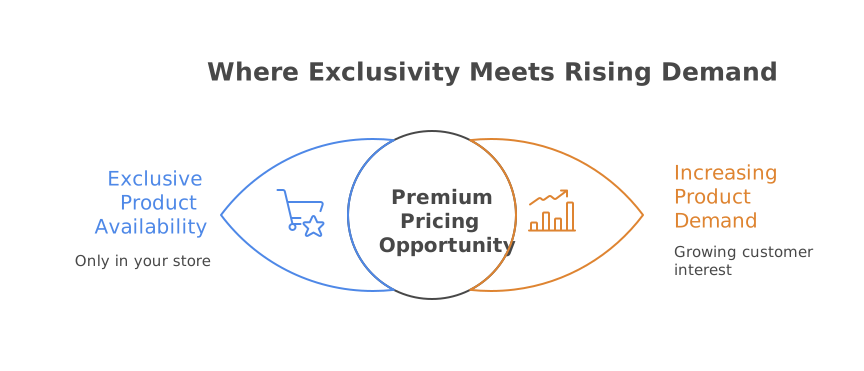
If you are the only seller in the region with the drill in stock, timely monitoring of competitors’ prices and inventory allows you to recognize your exclusive position. You can temporarily increase your price, as customers may be willing to pay more for immediate availability, boosting your profits.
Example 2: Countering Competitor Strategies
You and a direct competitor sell products from the same supplier. A sales drop prompts you to investigate. Price monitoring reveals the competitor reduces prices below your cost on weekends and holidays.
By performing test purchases to confirm accuracy, you deduce that the competitor receives additional supplier discounts. Armed with this information, you:
- Negotiate similar discounts with the supplier,
- Switch suppliers, or
- Introduce alternative products with a guaranteed margin.
Example 3: Enforcing Fair Practices
You are a dealer of a European gardening equipment supplier, whose products require offline sales due to technical complexity and service requirements.
After a revenue decline, price monitoring reveals that other dealers sell restricted items online at below-market prices. You gather evidence (e.g., screenshots) and report the violations to the supplier. As a result:
- The supplier terminates the violating dealers’ contracts,
- The market temporarily has fewer competitors,
- Your revenue and market share increase.
Competitor price monitoring is a critical tool for navigating today’s competitive business environment. Whether launching new products, addressing declining sales, or maintaining compliance, monitoring ensures you remain agile and proactive in responding to market challenges.
Find out who is selling your brand right now.
Order a trial service.

Market Price Monitoring to Create the Best Offer
In our previous publications, we have repeatedly emphasized the importance of analyzing market prices and overall market conditions.
In recent years, open sources have provided extensive information on how pricing impacts a potential customer's decision to purchase a product from a particular store. These sources highlight the critical role of understanding competitors' pricing strategies in driving online sales and profitability. Market price monitoring has thus become a key tool in competitive strategies. Below are some compelling facts:
Key Insights About Price Impact
- Consumer Behavior Study in the U.S.
A survey conducted a few years ago among smartphone shoppers in the United States revealed striking results:- 85% of buyers under the age of 35 compared prices across various online platforms before making a purchase.
- Many used specialized price comparison services that monitored prices for their chosen products across online stores.
- The main finding: 81% of potential buyers chose the platform with the lowest price for their desired product.
- Psychological Pricing Experiment

In one experiment, participants were asked to taste the same wine labeled with different price tags. The wine with the higher price was rated as having better taste, even though it was identical to the lower-priced wine.
- Impact of Pricing Psychology ($9.99 vs. $10.00)
Another study found that products priced at $9.99 sold better than those priced at $10.00, despite the difference being only one cent.- This is because customers tend to focus on the first digit of a price, perceiving $9.99 as "nine-something" rather than "ten."
These findings demonstrate that price is the most important factor influencing a buyer’s choice of seller. To set and maintain competitive prices, businesses must be aware of their competitors’ pricing strategies.
Market price monitoring allows companies to:
- Identify optimal pricing.
- Respond to competitors’ price changes.
- Ensure that their offers remain attractive to potential customers.
By leveraging effective market price monitoring, you can stay competitive, increase sales, and maximize profits.
What Does Price Monitoring Offer for Brands?
Price monitoring in online stores is a powerful tool for brands to navigate the competitive landscape effectively. By providing real-time insights into pricing trends and competitor strategies, it enables businesses to maintain market relevance, optimize their pricing, and enhance customer loyalty. Below are the key benefits of price monitoring for brands.
- Control Over Pricing Policy Compliance
Brands can track how their products are sold across various online platforms and ensure that Minimum Advertised Price (MAP) policies are being followed. This helps maintain pricing integrity and prevents price undercutting. - Optimizing Pricing Strategy
Monitoring competitors’ and their own product prices allows brands to adjust their pricing strategy in real-time, ensuring competitiveness without sacrificing profitability. - Improving Market Position
Analyzing price data helps brands determine optimal prices that attract buyers while preserving the perceived value of their products. - Increasing Customer Loyalty
Maintaining competitive prices helps retain customers, especially in highly competitive markets. - Understanding Competitor Behavior
Price monitoring provides insights into competitors’ pricing strategies, enabling brands to react promptly to market trends and adapt their own strategies accordingly. - Supporting Marketing Campaigns
Brands can leverage price data to evaluate the effectiveness of their promotions and discounts, as well as to make informed decisions about launching new marketing campaigns.
5 Benefits of Price Monitoring
It offers the following advantages:
- Gain a Competitive Edge
Regularly monitoring competitors' prices allows you to quickly adjust your pricing policy while remaining attractive to customers. - Increase Revenue
Up-to-date price data helps identify optimal pricing points to strike a balance between revenue growth and customer retention. - Retain Customers
In a competitive market, customers seek the best price-to-quality ratio. Maintaining competitive prices fosters customer loyalty and reduces churn. - Evaluate Promotion Effectiveness
Price monitoring allows businesses to assess the success of various promotions and discounts. Comparing pricing strategies helps refine marketing tactics, boosting sales and customer engagement. - Analyze Market Trends
Reviewing historical price data enables businesses to predict future market shifts and adjust their strategies accordingly.

By leveraging price monitoring, businesses can stay competitive, improve profitability, and better adapt to market dynamics.
How to Conduct Competitor Price Monitoring Online
There are several methods to gather competitor price information:
- Manual Price Monitoring
- Price Monitoring via Phone
- Monitoring Prices on Marketplaces and Price Aggregators
- Automatic Price Monitoring (Scraping)

Let’s explore the fundamental methods for online price monitoring:
1. Manual Competitor Price Monitoring
 This method is suitable for small online stores with a limited number of competitors and a narrow product range. Employees can manually collect competitor prices using computers or mobile devices. They visit competitors’ websites and record prices in Excel spreadsheets. Based on the findings, management can decide whether to adjust their pricing strategy.
Drawbacks:
- Time and labor-intensive: Employees must visit competitor sites daily to track price changes.
- Often assigned as an extra task to unmotivated employees, which can affect the accuracy of the data.
- If your product range expands, monitoring becomes more resource-intensive, requiring additional personnel.
2. Phone-Based Price Monitoring
Calling competitors to inquire about their prices is one of the most effective yet time-consuming methods. Employees posing as potential customers can gather data on prices, special offers, upcoming promotions, and loyalty programs.
Drawbacks:
- Requires strong acting skills to convincingly pose as potential customers.
- Time-consuming for employees but yields highly accurate pricing data.
- Can be complemented by test purchases, allowing you to discover competitors' supply chains and evaluate their pricing strategies.
3. Monitoring Prices on Marketplaces and Price Aggregators
Platforms like Hotline, Google Shopping, Amazon, and Rozetka can also be used for price monitoring. Simply search for a product, and the system provides all available offers.
Drawbacks:
- Marketplaces and price aggregators often serve as advertising platforms, and 80% of the data is promotional.
- Not all competitors list their products on these platforms.
- Prices displayed may not reflect the actual selling prices; clicking through to a seller’s site often reveals different offers.
- Some sellers intentionally lower prices to attract traffic, or even list products they don’t have in stock to redirect customers to alternatives.
4. Automatic Price Monitoring (Price Scraping)
Automatic competitor price monitoring is a regular process of collecting price and inventory data from various online platforms, where changes occur frequently, without requiring company personnel. In highly competitive industries, automated price monitoring systems are essential to track rapid market shifts and respond promptly.
For businesses with a wide range of products or numerous competitors, automatic price monitoring tools are the most efficient solution. These tools scrape price data from competitors’ websites and compile it into usable formats.
Advantages:
- Saves time and resources compared to manual methods.
- Provides accurate, real-time data across multiple platforms.
- Scalable for large inventories and numerous competitors.
Automatic monitoring tools eliminate human error and provide insights for creating competitive pricing strategies in dynamic markets.
By choosing the right price monitoring method for your business needs, you can stay ahead of competitors, optimize pricing strategies, and improve overall market performance.
Monitoring prices on competitors' websites using a parser
The most efficient method for tracking competitor prices is through automated  monitoring using specialized software known as a price scraper.
A price scraper is specially designed software that collects data about the prices of goods or services from the websites it visits. These programs can bypass anti-scraping defenses and are customizable to collect specific information in the exact format defined by the client. The process of collecting data using a scraper is called scraping.
Price scraping is the automated process of monitoring competitors’ or partners’ prices on a scheduled, ongoing basis. Its purpose is to provide accurate, real-time market data to optimize pricing strategies and maintain competitiveness.
Competitor price parsing for online resellers allows you to compare prices across online stores selling the same products as yours and develop a better price for your offering. Price parsing for suppliers allows you to compare competitors' offers with similar ones and understand how attractive your pricing is to customers.
There are several solutions for automating price monitoring using a parser.
- Buy a ready-made price parser.
- Develop your own competitor price parser.
Let's briefly review the capabilities of each of these methods.
Purchase a Prebuilt Price Scraper
A ready-made price scraper is a cost-effective, quick solution for businesses needing immediate results.
Develop a Custom Price Scraper
A tailored scraper is ideal for businesses with unique requirements, such as specific data formats, complex anti-scraping measures, or specialized platforms.
Buying a Prebuilt Price Scraper
If immediate price monitoring is a priority and there’s no time for custom development, a prebuilt price scraper can be purchased and configured for your specific needs.
How It Works:
- These scrapers typically collect data and compile it into Excel or Google Sheets.
- Their functionality is based on macros or special formulas, automating actions to extract information from websites.
Pros:
- Quick to implement for basic tasks.
- Ideal for platforms with minimal changes in structure or content.
Cons:
- Requires manual configuration of macros, which can be time-consuming.
- Limited to tabular output, restricting advanced analytics.
- Unsuitable for dynamic websites with frequent updates or complex anti-scraping mechanisms.
Developing a Custom Price Scraper
For businesses with specific needs or advanced requirements, creating a custom price scraper is a more flexible and scalable solution.
Who to Hire?
Freelancers: Cost-effective but may lack long-term support.
Specialized Companies: Offer expertise and ongoing maintenance but are more expensive.
Maintenance Challenges:
Websites often change layouts or implement anti-scraping measures, requiring regular scraper updates.
Decide who will handle maintenance—hiring a programmer or outsourcing to a service provider.
Pros:
Tailored to your specific requirements.
Capable of handling complex sites and collecting advanced datasets.
Cons:
- High initial investment in development.
- Requires ongoing maintenance to remain effective.
For more information on the challenges of scraping, refer to our article: "Competitor Price Scraping and Its Challenges."
Monitoring product prices using a dedicated service
Competitor price monitoring services are specialized programs that automate the process of tracking prices of goods or services offered by competitors on the market.
Advantages:
- Professional-grade software designed to scrape even complex, highly protected websites.
- Services regularly update scrapers to accommodate changes in website structures or defenses.
- Cost-effective compared to maintaining in-house infrastructure or relying on manual labor.
Example: Price Control Service
- Offers customizable solutions, including individual configurations for client-specific business tasks.
- Provides specialized tools for Marketplace Price Monitoring, a feature gaining popularity due to the growing dominance of marketplaces as a sales channel.
Which Option Is Best for You?
- Prebuilt Scrapers: Suitable for small-scale operations with simple requirements.
- Custom Scrapers: Ideal for businesses needing a long-term, tailored solution.
- Price Monitoring Services: Best for businesses looking for comprehensive, hassle-free solutions with ongoing support and maintenance.
For a detailed overview of the top 5 price monitoring platforms, including their features, pricing, and use cases, refer to our blog post on competitor price monitoring services.
Competitor price monitoring services and their key features
To effectively track competitor prices and make informed pricing decisions, price monitoring software must offer a comprehensive suite of features. From accurate product matching to user-friendly analysis tools, these capabilities ensure data accuracy, actionable insights, and seamless integration into business workflows. Below are the key features to look for in a reliable price monitoring solution.
1. AI-Powered Product Matching
- What It Is: The ability to identify identical or similar products across various platforms for accurate price comparison.
- Why It Matters: If the software cannot accurately match your products with comparable competitor offerings, the collected data will be inaccurate, leading to flawed pricing decisions.
- Outcome: Ensures precise data alignment and avoids pricing errors.
2. High-Quality Data Collection Across Platforms
Effective pricing decisions depend on the quality of collected data. Given the complexity of tracking competitors across multiple platforms, the software must be capable of:
- Gathering data from desktop and mobile websites as well as mobile apps.
- Extracting data from price aggregators, online stores, and marketplaces.
- Handling data across different regions, languages, and currencies.
- Conducting regular and real-time monitoring to ensure data freshness.
This ensures that the system provides comprehensive and timely insights for market-responsive pricing strategies.
3. Unit Measurement Standardization
- Purpose: To compare prices accurately, units of measurement must be standardized.
- Example: If a competitor sells motor oil in 1-liter bottles for 1,100 UAH, and you sell the same oil in 0.5-liter bottles for 650 UAH, your price per liter would actually be higher despite appearing cheaper at first glance.
- Impact: Without unit standardization, pricing analysis can lead to incorrect conclusions.
- Functionality Needed: The software should automatically convert and standardize units to provide meaningful comparisons.
4. User-Friendly Interface and Data Analysis Tools
Data collection is only valuable if it can be analyzed and acted upon. The software should offer tools that facilitate decision-making, including:
- Notifications about competitor price changes.
- An intuitive dashboard for quick analysis.
- Detailed reports and visual dashboards for comprehensive insights.
Additionally, the software should support:
- API integration for seamless connectivity with CRM and other systems.
- Easy data export options to integrate insights into existing workflows.

Why These Features Are Essential
A reliable competitor price monitoring system must provide precise, actionable, and timely data to enable businesses to:
- Adjust prices dynamically.
- Respond effectively to market changes.
- Maintain a competitive edge.
Price Control Service
Our service has been helping clients increase their profits with advanced price monitoring solutions. If your company needs a comprehensive tool for business growth, Price Control’s competitor price monitoring software is the solution. It addresses a wide range of needs—from price tracking to creating a tailored pricing system.
What can Price Control do
Price Control offers a robust proprietary software platform with features designed to meet diverse client needs. Our service ensures the highest data quality through:
- Automated product matching systems for precise competitor comparisons.
- Advanced tools to bypass anti-scraping protections, including complex mechanisms.
- Additional proxy servers for secure and comprehensive data collection.
- Built-in captcha-solving systems to streamline data extraction processes.
Key Features of Price Control
- Customizable Data Output
- Export data in various formats: XLS, XML, CSV, or directly integrate it into your system.
- Historical Data Storage
- Access a complete history of collected data via your personal client dashboard throughout our partnership.
- Price Dynamics Analysis
- Track and visualize pricing trends over time for better strategic decision-making.
- Competitor Price Drops
- Identify the first competitor to lower their price, giving you a competitive edge.
- Brand and Category Analysis
- Perform detailed analysis by specific brands or product categories.
- Product Movement Tracking
- Monitor the placement and status of products on competitor websites.
- Tailored Pricing Systems
- Build a custom pricing strategy using competitor data to optimize your offerings.
Price Control’s monitoring software can be further customized based on specific client requirements, ensuring it aligns perfectly with your business goals.
By choosing Price Control, you delegate all routine monitoring tasks to professionals:
- We set up and fine-tune the monitoring system to suit your needs.
- All you need to do is analyze the data we provide and act strategically.
 Price Control eliminates the complexity of price monitoring, allowing you to focus on growth and profitability.
Price Monitoring Table and Data Presentation in Your Dashboard

Our competitor price monitoring software offers a user-friendly interface for presenting data directly in your personal client dashboard. The system ensures:
- Clear and organized representation of price data.
- Easy access to historical data and trends for informed decision-making.
- Flexible export options to integrate insights into your existing tools.
Learn more about our successful collaborations by visiting the "Case Studies" section of our blog on pricecontrol.biz.
Our price monitoring software for online stores, combined with our extensive expertise and industry knowledge, can help your business unlock its full potential and achieve a new level of operational excellence.
We sincerely hope you’ll choose Price Control as your trusted partner. Let us take your business to greater heights!


One Comment
Great breakdown of internet price monitoring methods! The focus on real-time tracking and competitive analysis highlights how businesses can stay ahead in dynamic markets. Thanks for sharing these valuable insights!